A drain rarely clogs all at once. It slows, it gurgles, it asks for a plunger more often — and then one day it simply stops. Drain cleaning done properly starts with a question: is this the fixture, the branch line, or the main? The answer decides the tool, and this service exists to get that answer right.

Every drain in a house is part of one system: fixtures feed branch lines, branch lines feed the main drain, and the main feeds the sewer lateral to the street. A clog at a fixture is local and simple. A restriction in the main is shared — and shows up as several fixtures slowing together, gurgling at the lowest tub or toilet, and water that rises where it should fall.
The corridor's pipe writes most of the local story. Kitchens coat lines with grease year after year; bathrooms add hair and soap; old cast iron roughens inside and catches everything that passes; and clay laterals invite tree roots at every joint. Cleaning that ignores which of these it is facing is how the same clog gets paid for three times.
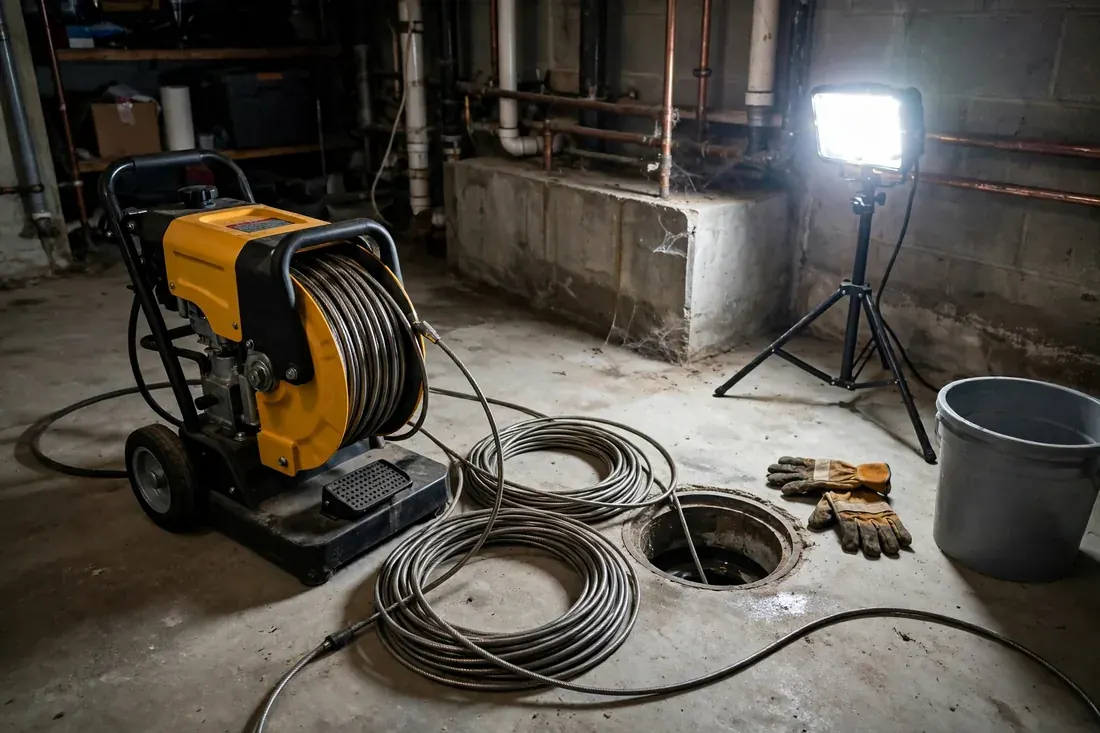
This service covers clearing and cleaning of household drains: fixture traps and branch lines, kitchen and bathroom lines, laundry drains, floor drains, and the main line out to the sewer lateral. Clearing is matched to the line — a cable machine for most blockages, water jetting where grease and scale coat the pipe walls, and a camera when the cause needs naming.
Cleaning has one honest limit worth stating plainly: it restores flow, it does not restore pipe. A line narrowed by decades of scale, or invaded by roots through a cracked joint, will flow again after cleaning — and will narrow again. When the camera shows that pattern, the lasting conversation is the sewer line page, and the plumber will say so rather than sell a fourth clearing.
Traps, pop-ups and branch lines cleared at the source — most single-fixture clogs live within a few feet of the drain opening.
Full-size cable machines through the cleanout for whole-house slowness and backups — the trunk, not just the twigs.
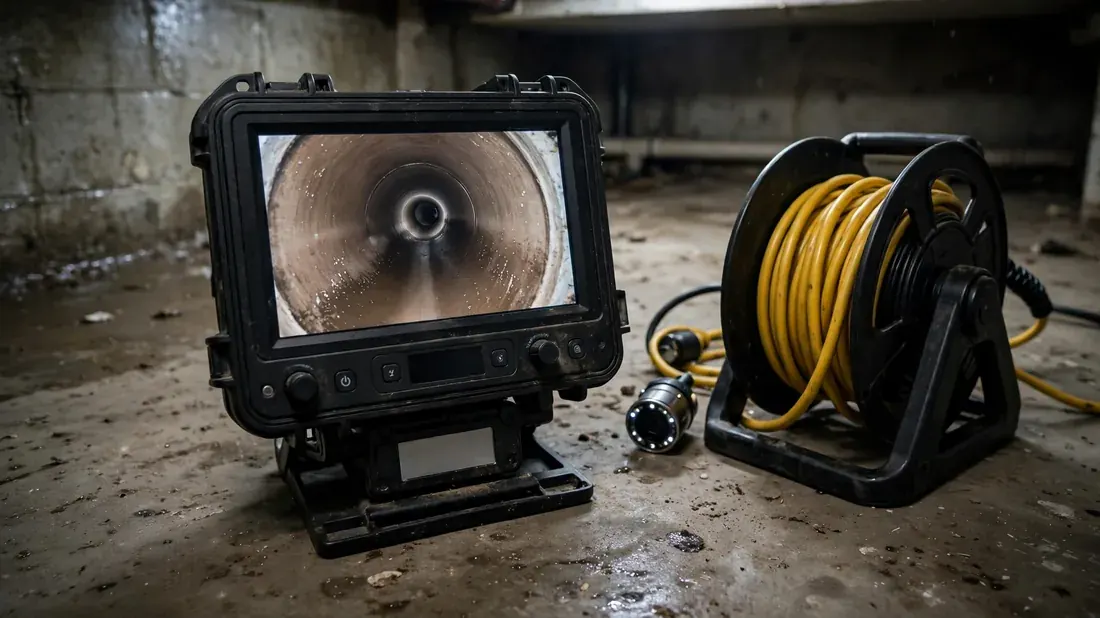
Where the cause is unclear or the clog repeats, a camera run shows roots, scale, bellies and breaks on screen before anyone guesses.
High-pressure water scouring for grease and scale that a cable only pokes a hole through — the difference between cleared and clean.
Which fixtures, how long, what makes it worse. The pattern is the diagnosis's first half, and it is gathered on the intake call.
A local plumber takes the job and starts from the right access point — fixture, cleanout or roof vent — rather than the nearest one.
The line is cleared and then proven: fixtures run together, water watched as it leaves. A drain that only looks clear has not finished the job.
If the camera or the clearing pattern shows roots, scale or a sag, you hear it plainly — with the options that follow, scoped before anything else begins.
The workhorse: interchangeable heads cut, retrieve and scour — sized differently for a sink branch and a main line, because one tool does not honestly fit both.
Water at high pressure strips grease and scale from pipe walls and flushes the debris out — the method that returns a coated line to its full width.
A lighted camera on a push rod shows the line's inside live and records distances, turning 'probably roots' into a picture with a location.
Augers and trap tools for the fixture-level clogs that make up half of all drain calls — cleared simply, without a machine where none is needed.
A sink cleared twice in a season, slow again within weeks, chemical openers in between making the trap water hazardous.
The branch jetted clean of its grease coat, flow restored to full width — and the cause named, so the pattern ends instead of repeating.
Tubs draining at a crawl, a toilet that gurgled when the washer ran, a family adjusting around the drains.
The main line cabled and camera-checked: roots at one joint, cut clear, with the joint's location on record for the repair conversation.
Water appearing around the floor drain after heavy rain and laundry days.
The lateral cleared of its sediment load and the floor drain left dry through the next storm cycle.
The situations this service exists for — described the way homeowners describe them on the call.
A drain that clogs again and again is not unlucky — it is telling you the restriction is deeper or the pipe itself is narrowed. Clearing plus camera ends the guessing.
Years of cooking fat line the pipe like a artery. A cable opens a hole; jetting removes the coating.
Air and gas moving the wrong way through traps point to a restriction or a venting issue downstream — found by pattern, fixed at the cause.
Because the cause is still there: a grease coat, scale narrowing, a root joint, or a sag that catches solids. A cable through the middle gives temporary flow. Cleaning the pipe wall — or repairing the defect — ends the cycle.
In sound pipe, yes — it is the standard method for coated lines. In pipe that is cracked, crushed or rotted, jetting is the wrong tool, which is why a camera look comes first when the line's condition is unknown.
On a single slow fixture it is a household choice, but know its limits: it cannot cut roots or lift a sag, and it leaves caustic water standing in the line for whoever works on it next. Tell the plumber if you used it — it changes how they protect themselves.
Run water at several fixtures. If only one misbehaves, the clog is local. If others gurgle, rise or slow in sympathy, the restriction is shared — the main line — and that is the description to give on the call.
Burst pipes, sewage backing up, water where it should not be — the call to make when the problem cannot wait for tomorrow.
No hot water, water that fades fast, rumbling tanks and pilot problems — diagnosed by test, not by guessing parts.
Replacing a failed tank or sizing a new one — matched on capacity, fuel and the house it serves, set and verified in place.
Root-filled laterals, cracked clay pipe, sagging lines — camera-located, honestly scoped, and repaired at the defect.
Meters that move with everything off, stains that grow, bills that make no sense — leaks located by instrument, then opened once.
Rusty water, weak pressure, one leak after another — when the supply system itself is the problem, replacing it is the repair.
Running toilets, leaking tubs, tired faucets and drains that sulk — the wettest room in the house, serviced fixture by fixture.
Sink drains clogged with the years, disposals that hum and quit, dishwasher connections and under-sink leaks — the kitchen's working plumbing.
Pumps that die silently and are discovered by the flood — replacement, new installation, check valves and backup systems.
The underground line from the street to the house — leaking joints, corroded runs, low pressure with a creeping meter.
One intake takes the job's description once and matches it with an independent local plumber who serves your city.
📞 Call NowMon–Fri 7 AM–10 PM · Sat 8 AM–10 PM · Sun 7 AM–9 PM ET
One way in while this area's local intake number is being connected: the contact route on this page. Describe the problem, and the matching starts. That is the whole system — by design.
Start here — one intake for all 16 cities, via the contact page while the local number is being connected.
✉For non-urgent questions about the service.
Mon–Fri 7 AM–10 PM · Sat 8 AM–10 PM · Sun 7 AM–9 PM
Describe the problem once — where it is, what it is doing, when it started — and the intake matches you with an independent local plumber who serves your city.
📞 Call Now or write to us rankandrent2+plumbing-new-jersey@gmail.com