A water heater rarely dies silently. It rumbles, it fades, it takes longer to recover — and then one morning the shower is cold. Most of those warnings trace to parts that can be tested and replaced: elements, thermostats, valves, dip tubes. This service matches you with a plumber who diagnoses by measurement, so the repair is the fault — not a tour of the parts shelf.

A tank heater is a simple machine with a short fault list. Electric models heat with two elements controlled by thermostats; gas models fire a burner under the tank. Wrapped around that simplicity are the parts that age: the dip tube that routes cold water to the bottom, the anode rod that sacrifices itself to corrosion, and the sediment that settles out of every gallon and blankets the tank floor.
Each fault has a signature. No hot water at all is usually energy — an element, a thermostat, a pilot, a tripped safety. Hot water that fades fast is usually mixing or capacity — a broken dip tube, a dead lower element, a tank half-full of sediment. Rumbling is sediment boiling under its blanket. A plumber who listens to the signature first replaces fewer parts to find the answer.
Repair covers the parts around the tank: heating elements, thermostats, gas valves and thermocouples, dip tubes, pressure-relief valves, and the flushing of sediment from a sound tank. It also covers the honest verdict when a symptom looks repairable but is not — delivered with the evidence, not a sales push.
What repair does not cover is the tank itself. A tank leaking from its body or seams has reached the end; no part fixes the vessel, and money spent trying is money taken from its replacement. When that is the finding, this service hands you to the installation page with a clear head — and the plumber will show you the weep that decided it.
Elements and thermostats checked with a meter, gas components checked by their signs — the fault proven before a part is opened.
Where the tank is sound, a drain-down and flush that restores heating speed and quiet — with an honest report on what came out.
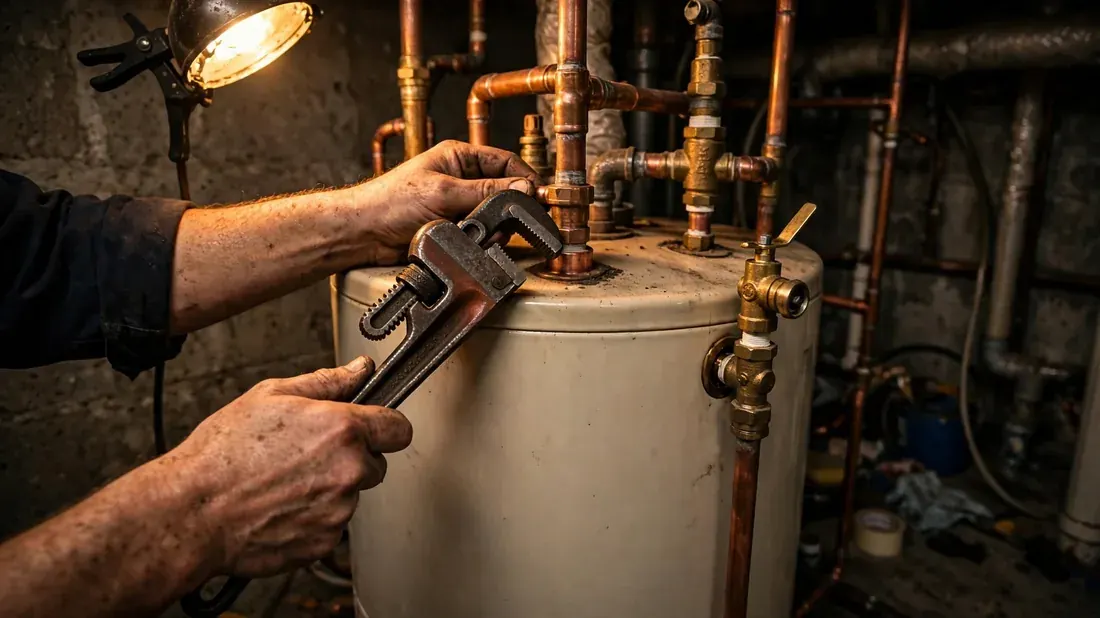
The unglamorous parts that cause the strangest symptoms: dip tubes, relief valves, and the supply fittings that weep at the tank top.
Every repair visit ends with the tank's honest state: its age, its anode's likely condition, and whether the next fault should be a repair or a replacement conversation.
Cold from the start, or hot then fading? New noises? Sudden or gradual? The pattern narrows the fault list before anyone drives — give it on the intake call.
The job goes to a local plumber who services tank heaters daily — gas or electric, the call sorts which.
Diagnosis by instrument first; the part that failed is the part replaced, and the old part's evidence stays available for you to see.
Scope confirmed with you before work begins, and hot water verified at the tap before the visit ends.
Continuity and draw tests separate a dead element from a dead thermostat in minutes — the difference between two very different invoices of time.
Full-port draining and agitation that clears the tank floor without stressing a tired drain valve more than it can bear.
On gas units: draft, flame pattern and venting reviewed as part of any firing fault, because a heater that will not fire is sometimes a vent telling the truth.
A relief valve and a thermostat are safety devices before they are conveniences; both get verified, not assumed.
A family timing showers, the second one always lukewarm, the tank rumbling like a kettle.
Sediment flushed, the lower element replaced after testing dead — and full mornings of hot water restored on the same tank.
A cold house, a silent heater, a panel breaker that had not tripped.
The fault traced to a failed upper thermostat, replaced and verified at every tap before the plumber left.
A gas heater relit a dozen times, always out by morning.
A failing thermocouple proven and replaced, the flame holding through the week — with the venting checked while the cover was off.
The situations this service exists for — described the way homeowners describe them on the call.
Dip tubes, lower elements and sediment share this symptom; testing separates them. The fix is specific because the diagnosis is.
Sediment boiling under its own blanket — the sound of a tank losing capacity and heating efficiency at once.
No heat at all is an energy-path fault: power, element, thermostat, pilot or valve. A short list, tested in order.
The common causes are sediment taking up tank space, a broken dip tube mixing cold water at the top, or a failed lower element heating only part of the tank. All three are diagnosable in one visit — and our blog guide walks through each pattern in detail.
Rumbling itself is sediment noise, not an explosion risk — but it means the tank is working harder, holding less, and aging faster. It is a schedule-soon symptom, not an ignore-forever one.
At that age the tank itself is the question. A modest part repair can still be sensible, but any larger spend should be weighed against replacement — especially if the heater sits above finished rooms. The plumber's verdict on the visit will lay out both.
Yes — that valve is the tank's last safety device, and dripping can mean excess pressure, excess temperature, or a valve at the end of its life. It should be tested and the cause found, not plugged or ignored.
Burst pipes, sewage backing up, water where it should not be — the call to make when the problem cannot wait for tomorrow.
Slow sinks, tubs that drain at a crawl, drains that gurgle — clearing matched to the line, not just the fixture.
Replacing a failed tank or sizing a new one — matched on capacity, fuel and the house it serves, set and verified in place.
Root-filled laterals, cracked clay pipe, sagging lines — camera-located, honestly scoped, and repaired at the defect.
Meters that move with everything off, stains that grow, bills that make no sense — leaks located by instrument, then opened once.
Rusty water, weak pressure, one leak after another — when the supply system itself is the problem, replacing it is the repair.
Running toilets, leaking tubs, tired faucets and drains that sulk — the wettest room in the house, serviced fixture by fixture.
Sink drains clogged with the years, disposals that hum and quit, dishwasher connections and under-sink leaks — the kitchen's working plumbing.
Pumps that die silently and are discovered by the flood — replacement, new installation, check valves and backup systems.
The underground line from the street to the house — leaking joints, corroded runs, low pressure with a creeping meter.
One intake takes the job's description once and matches it with an independent local plumber who serves your city.
📞 Call NowMon–Fri 7 AM–10 PM · Sat 8 AM–10 PM · Sun 7 AM–9 PM ET
One way in while this area's local intake number is being connected: the contact route on this page. Describe the problem, and the matching starts. That is the whole system — by design.
Start here — one intake for all 16 cities, via the contact page while the local number is being connected.
✉For non-urgent questions about the service.
Mon–Fri 7 AM–10 PM · Sat 8 AM–10 PM · Sun 7 AM–9 PM
Describe the problem once — where it is, what it is doing, when it started — and the intake matches you with an independent local plumber who serves your city.
📞 Call Now or write to us rankandrent2+plumbing-new-jersey@gmail.com