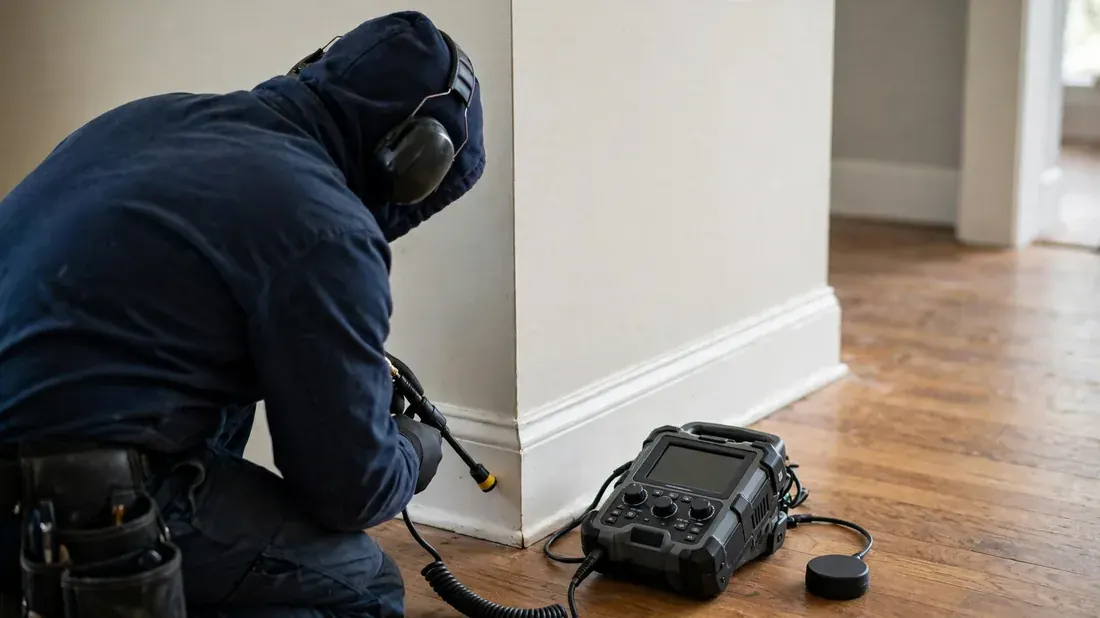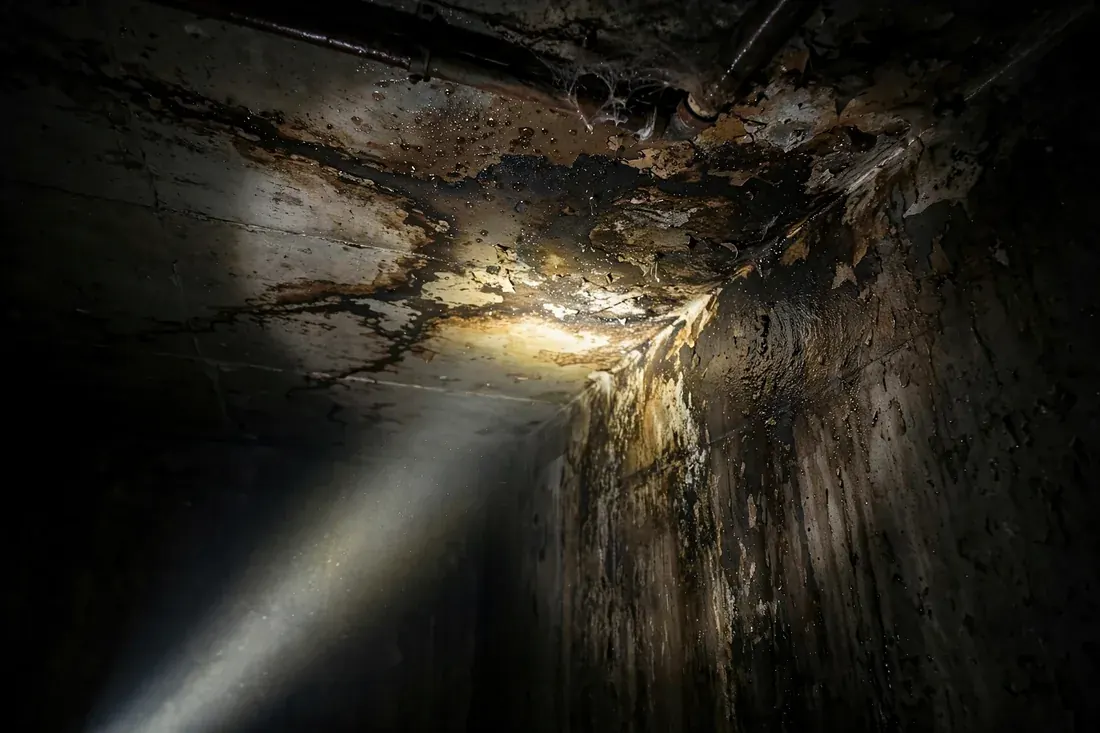
A hidden leak is a race between the water and the house it is soaking. The old way to find one was to open walls until the ceiling confessed. The modern way is to listen and look first: acoustic sensors hear pressurized water escaping, thermal cameras see moisture's cool signature, and a pressure test proves which line is guilty. Locate first, open once — that is this service.

Leaks hide in two systems. Supply leaks are pressurized, so they run constantly — a pinhole in copper, a weeping joint, a cracked fitting — and they betray themselves to the water meter, which moves even when every tap is closed. Drain leaks are intermittent: they only run when the fixture above them does, and they announce themselves with stains and smells rather than meter movement.
Water also lies about its address. It travels along pipes, joists and the tops of ceilings before it drips or stains, so the visible evidence is often a room away from the source. Treating the stain as the leak's location is the classic mistake — and the reason detection is a discipline of instruments and isolation tests rather than faith in the nearest wet spot.
Detection covers locating: confirming a leak exists, isolating it to a line or zone, and pinpointing the source closely enough that the repair opening is small and in the right place. The tools are matched to the system — acoustic and pressure methods for supply lines, dye, camera and controlled water tests for drain lines.
Detection is not the repair itself, and that separation is deliberate: first the leak is found and shown to you, then the repair is scoped on facts and confirmed with you before anything opens. Bundling the two into one vague visit is how homeowners end up with three holes and no answer. Here, the answer comes first.
Proof the leak exists and which zone it lives in — supply or drain, hot or cold, this floor or that one — before instruments come out.
Listening equipment that follows the sound of escaping water through floors and walls to the point where it is loudest: the source.
A camera that reads surface temperatures and shows moisture's cool trace inside a wall — the map that aims the single opening.
The visit ends with the leak located and the repair described precisely — what will be opened, what will be replaced, confirmed with you before it starts.
On the intake call: the meter behavior, the stain's location and history, the sounds. Your observations are the first instrument — report them fully.
The visit begins with proof: meter tests and zone isolation that turn a suspicion into a located system and side.
Acoustic and thermal tools narrow the zone to a point. You see or hear the evidence yourself — the finding is shown, not just stated.
With the leak located, the repair is scoped tightly and confirmed with you. One opening, in the right place, for a known fault.
Ground microphones and probes that amplify the hiss of pressurized water escaping — audible through concrete, tile and framing.
Moisture cools surfaces as it evaporates; the camera turns that invisible difference into a picture of the wet path inside a wall.
A line is isolated and pressurized, then watched. A line that cannot hold pressure is guilty; a line that holds is cleared — proof, either way.
For the unpressurized side: cameras that travel drain lines and dyes that trace which fixture's water arrives at a stain.
A homeowner certain something was wrong, no water visible anywhere, and a spouse certain there was not.
The meter test proved the leak; acoustics found a pinhole behind a kitchen wall. One small opening, one fitting, and a meter at rest.
A living-room ceiling stain doubling across a season, blamed on the roof twice by two different visitors.
Thermal imaging traced the moisture to a drain joint in the bath above. The roof was innocent; the joint was not.
A green, spongy line across a front yard in a dry month, the meter creeping overnight.
The service line located leaking at a joint by the sidewalk — repaired at the spot the instruments named, not along a trench of guesses.
The situations this service exists for — described the way homeowners describe them on the call.
Copper and aging galvanized lines leak at pinhole scale for months. Acoustic location finds them while the damage is still a stain, not a structure.
Lines under floors and yards fail silently. Isolation and listening locate them without excavating the whole run on suspicion.
The leak that only runs when the upstairs shower does — traced by controlled testing rather than by waiting for the ceiling to worsen.
Almost certainly, yes — with everything off, a moving meter means water is leaving the system somewhere: a hidden line, an underground service pipe, or a toilet running silently. The toilet check comes first in any detection visit because it is the most common culprit.
The opposite: detection exists so that the opening is small and singular. Acoustic and thermal tools locate the source first. A repair that starts with exploratory holes in several walls is working in the wrong order.
Yes — that is a standard use of acoustic equipment, which hears pressurized water through slab. The location is marked on the surface, and the repair scope is built around that mark.
By controlled testing: fixtures are run one at a time under observation, dye traces the path, and a camera inspects the line's inside. Intermittent leaks take method, not luck.
Burst pipes, sewage backing up, water where it should not be — the call to make when the problem cannot wait for tomorrow.
Slow sinks, tubs that drain at a crawl, drains that gurgle — clearing matched to the line, not just the fixture.
No hot water, water that fades fast, rumbling tanks and pilot problems — diagnosed by test, not by guessing parts.
Replacing a failed tank or sizing a new one — matched on capacity, fuel and the house it serves, set and verified in place.
Root-filled laterals, cracked clay pipe, sagging lines — camera-located, honestly scoped, and repaired at the defect.
Rusty water, weak pressure, one leak after another — when the supply system itself is the problem, replacing it is the repair.
Running toilets, leaking tubs, tired faucets and drains that sulk — the wettest room in the house, serviced fixture by fixture.
Sink drains clogged with the years, disposals that hum and quit, dishwasher connections and under-sink leaks — the kitchen's working plumbing.
Pumps that die silently and are discovered by the flood — replacement, new installation, check valves and backup systems.
The underground line from the street to the house — leaking joints, corroded runs, low pressure with a creeping meter.
One intake takes the job's description once and matches it with an independent local plumber who serves your city.
📞 Call NowMon–Fri 7 AM–10 PM · Sat 8 AM–10 PM · Sun 7 AM–9 PM ET
One way in while this area's local intake number is being connected: the contact route on this page. Describe the problem, and the matching starts. That is the whole system — by design.
Start here — one intake for all 16 cities, via the contact page while the local number is being connected.
✉For non-urgent questions about the service.
Mon–Fri 7 AM–10 PM · Sat 8 AM–10 PM · Sun 7 AM–9 PM
Describe the problem once — where it is, what it is doing, when it started — and the intake matches you with an independent local plumber who serves your city.
📞 Call Now or write to us rankandrent2+plumbing-new-jersey@gmail.com