The kitchen sink is the most used drain in the house and the most abused: hot grease poured away, food scraped through, a disposal grinding what the drain beyond it was never sized to swallow. Kitchen plumbing trouble is rarely mysterious — it is accumulation, inside the pipe and under the sink — and this service deals with both, from the strainer to the branch line.

Grease is the kitchen line's biography. Poured hot, it runs as liquid — then cools on the pipe wall a few feet in, layer on layer, until the line's width is a rumor. Add disposal-ground food, which a narrowed line cannot carry, and the clog that finally stops the sink has been building for years. That is why a kitchen clog that returns quickly after cabling is telling the truth about the pipe, not about the plumber.
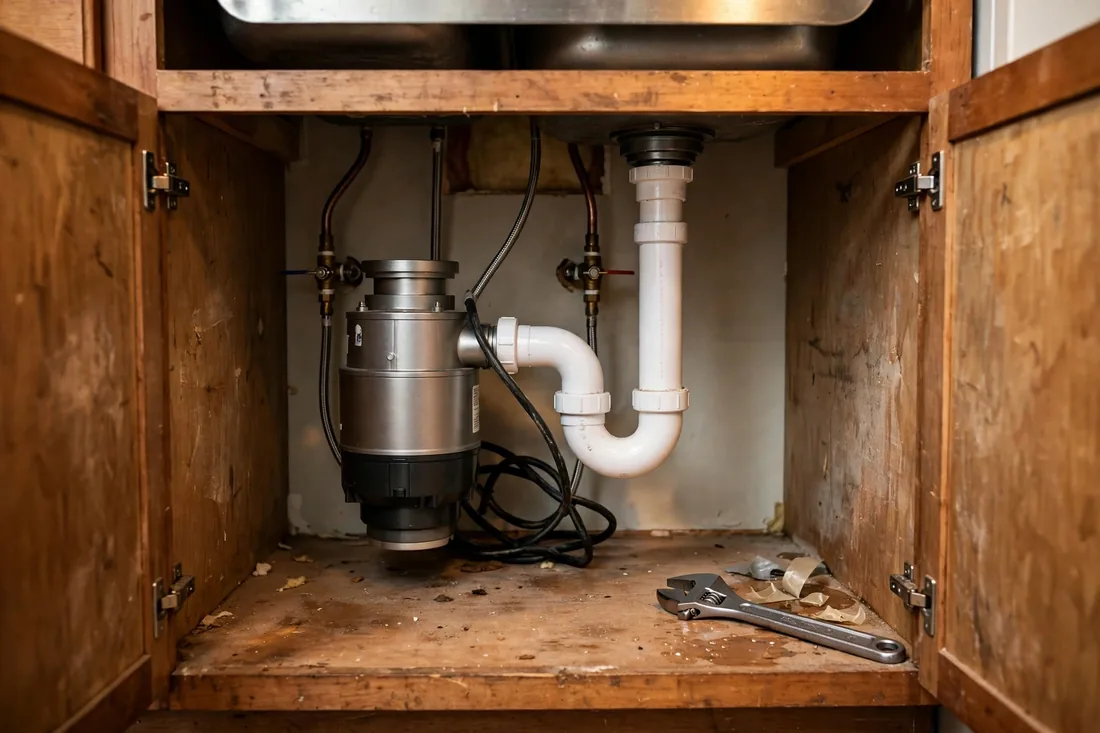
Under the sink is the second kitchen system: supply lines, shut-offs, the trap, the dishwasher's feed and drain, and the disposal — a crowd of joints in a dark cabinet, each capable of a slow weep that ruins the cabinet floor and the subfloor quietly before it is ever seen. Kitchen work means looking at both systems, because the call about a clog often arrives in a cabinet that is already damp.
This service covers the kitchen's plumbing: sink drains and branch lines, garbage disposals repaired or replaced, dishwasher water and drain connections, faucets, and under-sink supply and trap work. It includes clearing a kitchen line properly — cabling, and jetting where the grease coat demands it — with a camera when the pattern suggests the line itself has narrowed or sagged.
Appliance internals are the border: a dishwasher's pump or a refrigerator's board belongs to appliance repair. What this service owns is everything the appliance connects to — and an honest word when the fault proves to be inside the machine rather than in the plumbing serving it. The icemaker line and its saddle valve, though, are plumbing, and notoriously guilty ones.
The sink branch cleared, and where grease coats the line, jetted back to full width — the difference between a hole and a cleaning.
Jams cleared, leaks diagnosed to unit or mounting, and failed units replaced and sealed — with the reset and the wrench tried before the replacement is declared.
Feed lines, drain loops and air gaps set correctly — the high loop that keeps sink water out of the machine is installed plumbing, not a suggestion.
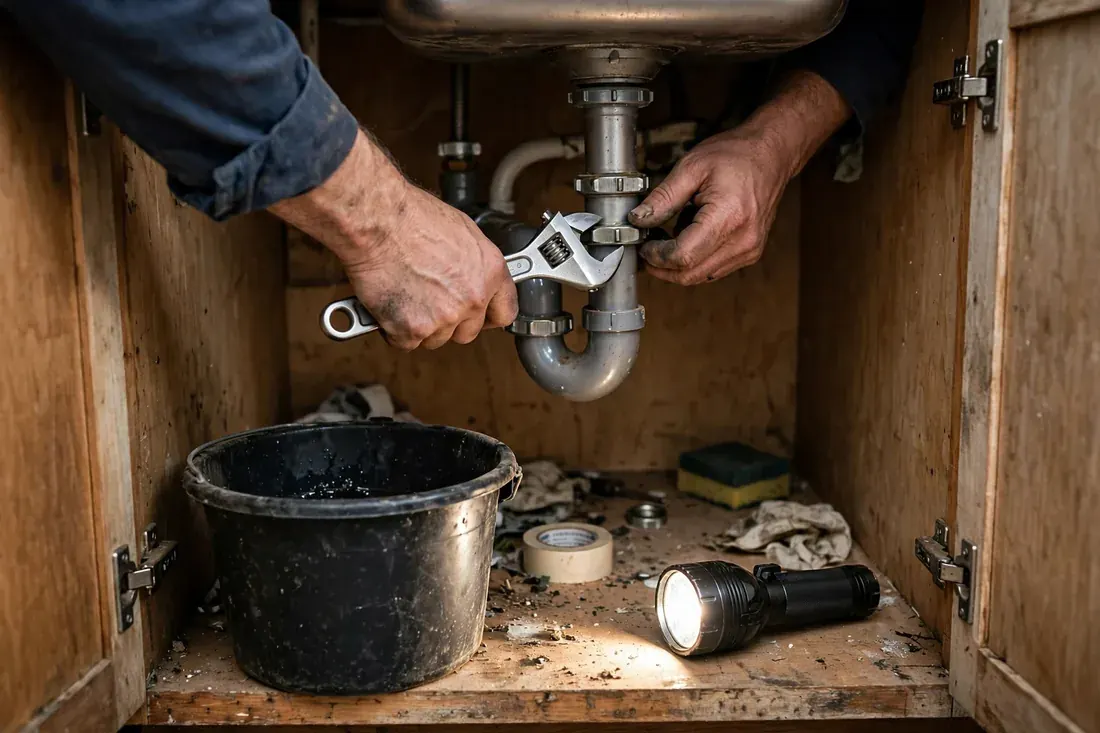
Traps, supplies and shut-offs replaced where age or weeping has marked them — the cabinet dried out and left verifiably dry.
Slow or stopped? Disposal dead or leaking? Damp below? On the intake call, kitchen faults sort fast when the description names the fixture and the behavior.
A local plumber takes the kitchen as scoped — drain, disposal, connections, or the under-sink survey the description calls for.
Clearing goes to the pipe wall when grease is the cause; leaks are traced to the joint that weeps, not the cabinet that suffers.
Sink, disposal and dishwasher run together at the end, cabinet inspected dry — the kitchen returned to work, proven under its real load.
Hot work for a greasy line: water pressure that strips the coat from the pipe wall and flushes it away — the kitchen line's one true reset.
Cable machines sized for branch lines, run from the trap arm or the cleanout — clearing that reaches the restriction instead of waving at it.
The under-sink survey done properly: damp found where eyes guess, joints watched under pressure and flow.
Jam wrenches, mounting tools and the tester's patience — because half of all dead disposals are a tripped reset or a jam, not a death.
A double sink backing into itself, the disposal's roar making it worse, a plunger kept on standby.
The branch jetted clean of its grease years — both bowls draining at full speed, the plunger retired to the garage.
A musty smell opening the under-sink door, the cabinet floor dark and giving under a stored bottle.
The weeping trap and a tired supply line replaced, the cabinet dried and checked — and the subfloor caught before it became a project.
A disposal silent after a jam, declared finished by the household.
A jam cleared with the wrench and the reset restored — five minutes of diagnosis standing between a repair and a replacement.
The situations this service exists for — described the way homeowners describe them on the call.
The corridor's kitchens drain through their own history. Jetting removes the history; cabling alone schedules its return.
Small weeps in dark cabinets do outsized damage. Traced to the joint and renewed, they end; ignored, they renovate.
The two machines a kitchen's plumbing serves daily — their connections, loops and drains kept honest so the machines can be.
Because cabling opens a path through grease without removing the grease. The coat remains, catches new debris, and the clog rebuilds. Jetting — which strips the pipe wall — is the clearing that changes the timeline.
No — the hot water only carries it further before it cools and coats the pipe. Grease belongs in a container and the trash. It is the single habit that decides how often a kitchen line needs professional attention.
Usually not — a hum means power is reaching a jammed or stuck unit. The jam wrench from below and the reset button cure most of them. A plumber will try both before anyone talks replacement.
Either the machine's own pump is failing — appliance territory — or its drain path is restricted: a clogged filter, a kinked hose, or a drain loop that has dropped. The plumbing side is checked first because it is checked quickly, and it is the culprit often enough to matter.
Burst pipes, sewage backing up, water where it should not be — the call to make when the problem cannot wait for tomorrow.
Slow sinks, tubs that drain at a crawl, drains that gurgle — clearing matched to the line, not just the fixture.
No hot water, water that fades fast, rumbling tanks and pilot problems — diagnosed by test, not by guessing parts.
Replacing a failed tank or sizing a new one — matched on capacity, fuel and the house it serves, set and verified in place.
Root-filled laterals, cracked clay pipe, sagging lines — camera-located, honestly scoped, and repaired at the defect.
Meters that move with everything off, stains that grow, bills that make no sense — leaks located by instrument, then opened once.
Rusty water, weak pressure, one leak after another — when the supply system itself is the problem, replacing it is the repair.
Running toilets, leaking tubs, tired faucets and drains that sulk — the wettest room in the house, serviced fixture by fixture.
Pumps that die silently and are discovered by the flood — replacement, new installation, check valves and backup systems.
The underground line from the street to the house — leaking joints, corroded runs, low pressure with a creeping meter.
One intake takes the job's description once and matches it with an independent local plumber who serves your city.
📞 Call NowMon–Fri 7 AM–10 PM · Sat 8 AM–10 PM · Sun 7 AM–9 PM ET
One way in while this area's local intake number is being connected: the contact route on this page. Describe the problem, and the matching starts. That is the whole system — by design.
Start here — one intake for all 16 cities, via the contact page while the local number is being connected.
✉For non-urgent questions about the service.
Mon–Fri 7 AM–10 PM · Sat 8 AM–10 PM · Sun 7 AM–9 PM
Describe the problem once — where it is, what it is doing, when it started — and the intake matches you with an independent local plumber who serves your city.
📞 Call Now or write to us rankandrent2+plumbing-new-jersey@gmail.com