Between the city main in the street and the shut-off in your basement runs the water service line — buried, pressurized, and entirely the homeowner's once it crosses the property line. When it leaks, it rarely announces itself with a fountain; it whispers: a soft stripe in the lawn, pressure that has thinned, a meter that creeps overnight. This service finds that whisper and answers it.

The corridor's service lines are a museum of plumbing eras: lead in the oldest stock — still present in parts of Elizabeth and Newark's oldest streets — galvanized steel in the next generation, copper after that, and modern plastic in the newest work. Each fails in its own dialect. Galvanized corrodes through. Copper pinholes, and suffers where soil chemistry attacks it. Joints of every era loosen as decades of freeze and thaw work the ground.
Because the line is pressurized, its leaks are constant — day and night, whether the house uses water or not. That constancy is the diagnostic gift: a meter that moves with the house at rest, on a line isolated from the house's own plumbing, proves the service line guilty before a single shovel enters the yard.
This service covers the homeowner's service line from the property-side connection to the house: locating leaks, spot repair at a found fault, and full replacement of lines whose material or condition has ended their service — including the lead and galvanized replacements that older corridor homes increasingly need, with the permit and utility coordination those jobs involve in your municipality.
The boundary is the curb stop and the main beyond it: that side belongs to the water utility. The isolation tests that open every job establish which side of the boundary a leak sits on, so a utility problem is reported to the utility with evidence — not repaired at homeowner expense on a guess.
House plumbing and service line tested separately, so the guilty section is proven before the yard is opened — evidence, then excavation.
Acoustic location along the buried run, marking the fault's position on the surface — the discipline that keeps the dig to one honest opening.
Where the line's material and condition deserve it, the repair replaces the failed section and tests the rest under pressure.
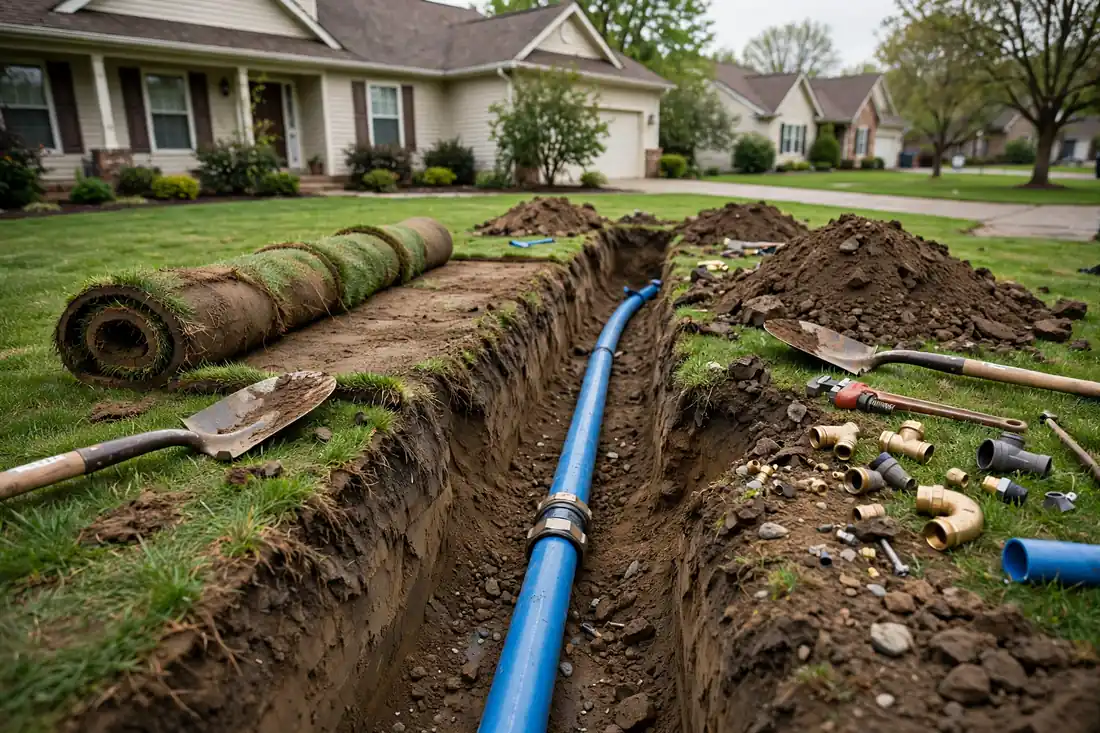
Where the line is lead, galvanized through, or failing in sequence — a new line end to end, trench or trenchless as the route and soil allow.
Meter behavior, pressure change, the yard's soft stripe. On the intake call, those three facts begin the isolation logic before anyone drives.
Tests separate house from line and line from the city's side. The scope is written against the guilty one — stated and confirmed with you.
The fault marked on the surface, the opening made at the mark, and the repair or replacement carried out at the true site.
The line held under pressure and watched, the meter confirmed at rest, the yard backfilled — the whisper answered, on the record.
Listening along the buried run for the hiss of pressurized escape — loudest at the fault, and marked there on the grass.
Valves and gauges that divide the system into provable sections — the method that keeps a utility-side leak from becoming a homeowner's excavation.
New line drawn through the old line's path where soil and route allow — a replacement with gardens and driveways largely intact.
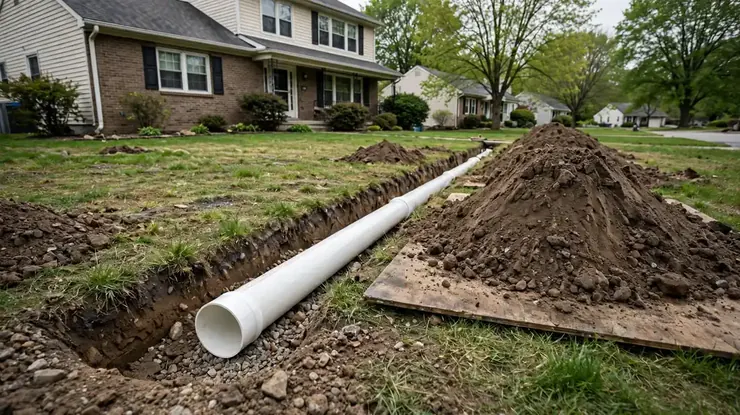
Traditional digging, aimed by the instruments — still the answer where a line has collapsed, offset, or runs where trenchless cannot.
A meter moving all night in a house that used nothing, the yard dry, the basement dry.
Isolation proved the service line; acoustics marked a joint by the maple. One opening, one fitting — and a meter finally at rest.
A front lawn sinking along a line from curb to porch, greener than the dry lawn around it.
A galvanized line found weeping along a corroded run — replaced end to end, and the stripe level by the next season.
An older Elizabeth home whose service line predated everyone who had ever lived in it.
The line replaced under the municipality's process, the house's water running through modern pipe for the first time in its history.
The situations this service exists for — described the way homeowners describe them on the call.
Constant, invisible and meter-provable. Located by sound and repaired at the mark — not hunted by trench.
Pressure lost to the pipe's own rust. Where a section has gone, the evidence usually argues replacement — and the scope says so plainly.
The oldest corridor stock carries them still. Replacement is the permanent answer, handled through each town's process and permits.
By isolation: the house's main shut-off is closed and the meter watched. If it still moves, water is escaping between the meter and the house — the service line. If it stops, the leak is inside. The test opens every job because it divides the bill's responsibility as cleanly as the diagnosis.
The utility owns the main and its side of the connection; the homeowner owns the service line from the property connection to the house. The isolation tests exist partly to establish that line, with evidence, before money is spent.
Yes — a pressurized leak runs twenty-four hours a day. Even a modest one passes more water in a month than the household uses on purpose. It is why a creeping meter is worth acting on promptly rather than watching for another quarter.
Lead lines are at the end of their era, and many corridor municipalities run replacement programmes or requirements around them. A plumber can confirm your line's material at the entry point and walk through your town's process — it is a planned job, best done before the line makes the decision itself.
Burst pipes, sewage backing up, water where it should not be — the call to make when the problem cannot wait for tomorrow.
Slow sinks, tubs that drain at a crawl, drains that gurgle — clearing matched to the line, not just the fixture.
No hot water, water that fades fast, rumbling tanks and pilot problems — diagnosed by test, not by guessing parts.
Replacing a failed tank or sizing a new one — matched on capacity, fuel and the house it serves, set and verified in place.
Root-filled laterals, cracked clay pipe, sagging lines — camera-located, honestly scoped, and repaired at the defect.
Meters that move with everything off, stains that grow, bills that make no sense — leaks located by instrument, then opened once.
Rusty water, weak pressure, one leak after another — when the supply system itself is the problem, replacing it is the repair.
Running toilets, leaking tubs, tired faucets and drains that sulk — the wettest room in the house, serviced fixture by fixture.
Sink drains clogged with the years, disposals that hum and quit, dishwasher connections and under-sink leaks — the kitchen's working plumbing.
Pumps that die silently and are discovered by the flood — replacement, new installation, check valves and backup systems.
One intake takes the job's description once and matches it with an independent local plumber who serves your city.
📞 Call NowMon–Fri 7 AM–10 PM · Sat 8 AM–10 PM · Sun 7 AM–9 PM ET
One way in while this area's local intake number is being connected: the contact route on this page. Describe the problem, and the matching starts. That is the whole system — by design.
Start here — one intake for all 16 cities, via the contact page while the local number is being connected.
✉For non-urgent questions about the service.
Mon–Fri 7 AM–10 PM · Sat 8 AM–10 PM · Sun 7 AM–9 PM
Describe the problem once — where it is, what it is doing, when it started — and the intake matches you with an independent local plumber who serves your city.
📞 Call Now or write to us rankandrent2+plumbing-new-jersey@gmail.com