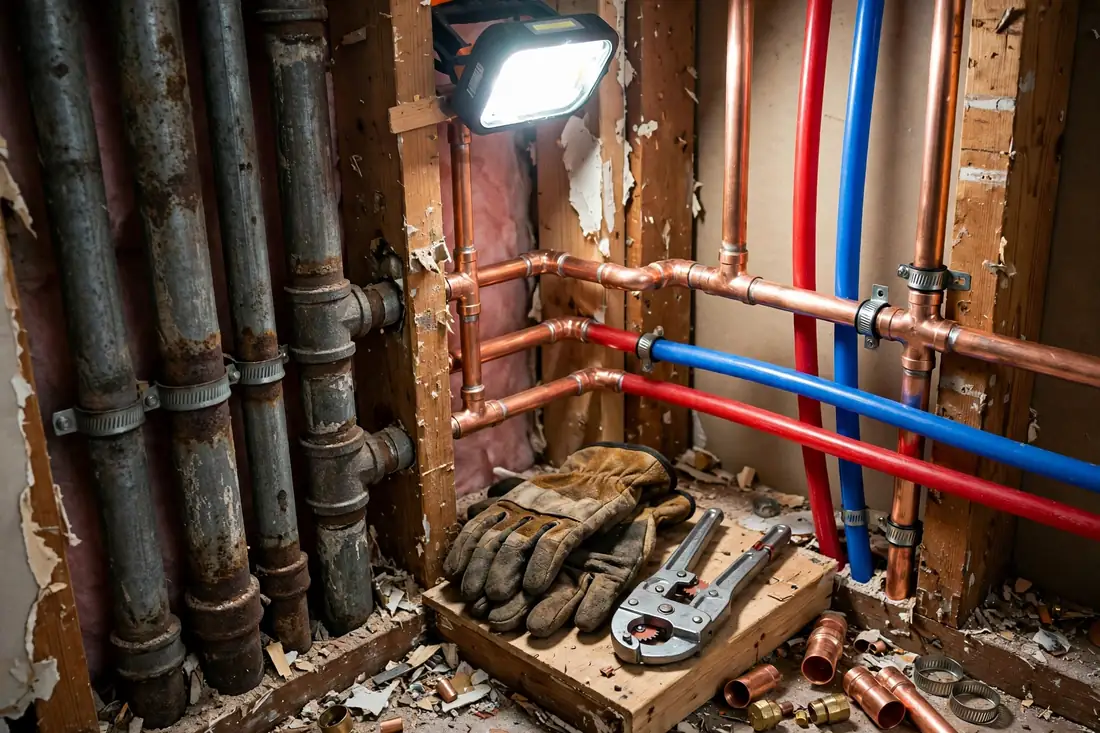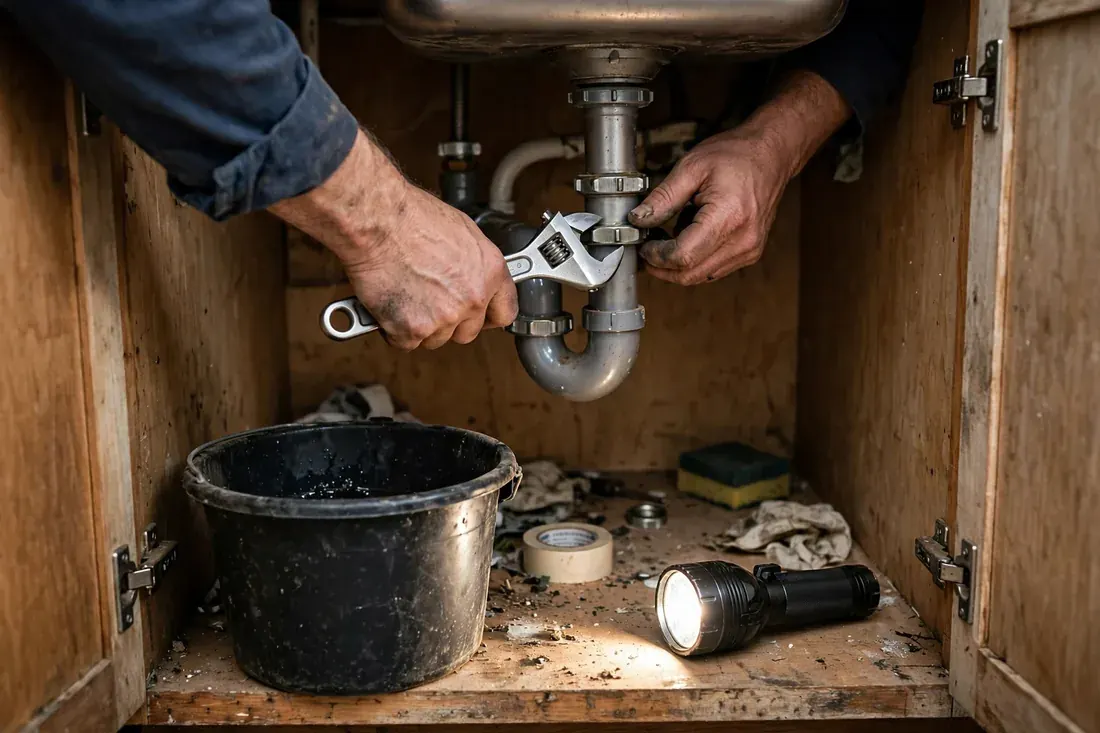
Every house reaches the point where its supply pipes stop being a system and start being a schedule of failures: a leak in the spring, rusty water by summer, pressure that fades a little more each year. Repiping is the decision to fix the system instead of the symptom — replacing the old lines with new copper or PEX, and ending the cycle rather than booking its next installment.

Galvanized steel — the gray, threaded pipe in so much of this corridor's older housing — corrodes from the inside. Zinc coating goes first, then the steel itself rusts inward, narrowing the passage year by year. The signatures are unmistakable: water that runs rusty after sitting, pressure that disappoints at every fixture, and leaks that begin at threaded joints where the wall of the pipe has thinned to foil.
Copper ages differently — decades of good service, then pinholes, often several in the same run once they start. Polybutylene, where it survives from its era, is simply replaced on sight by most plumbers. The question repiping answers is not whether one more patch holds; it is whether the pattern has become the system's normal state. When repairs start introducing themselves by season, it has.
A repipe replaces the water supply system: the runs from the main shut-off through the house to every fixture, in copper or PEX chosen for the building and the budget of disruption you can accept. It can be whole-house — the complete cure — or sectioned, replacing the worst runs first in a planned order, as long as the plan is honest about being a plan and not an endless patch.
Repiping covers supply lines, not drains — though the two conversations often happen together, since a house old enough to need one frequently needs eyes on the other. It also involves permits and inspection in these municipalities, and wall openings that get closed as part of the work's finish. All of that belongs in the scope you approve, stated before the first pipe is cut.
The existing pipe mapped — materials, runs, shut-offs, the worst sections — so the scope replaces the system, not just the visible parts.
Both are sound modern materials with different strengths in routing, disruption and repair. The choice is made with the house's layout in view, not by habit.
A planned repipe keeps the house livable: sections are cut over and tested so the household is not left dry for the duration.
Every new run pressure-tested and every fixture run before the walls close — the new system's first exam, passed in front of you.
Rusty water, fading pressure, the leak history. On the intake call, that pattern is what separates a repipe conversation from a repair visit.
A plumber maps the existing system and scopes the replacement — whole house or phased — with the permit steps for your town included, confirmed with you before work.
New lines run alongside the old until each zone is ready, then cut over and tested. The house keeps its water through most of the project.
Full pressure at every fixture, joints inspected, openings closed, and the new system's layout documented for whoever owns the house next.
Flexible lines that route through framing with few joints — fewer joints, fewer future leaks — joined with crimp or expansion fittings that test clean.
The traditional material, still unmatched in some runs: rigid, proven, and honest about its workmanship at every joint.
Air or water pressure held on the new system and watched — the test that has to pass before a single wall closes over new pipe.
Running new lines through closets, chases and joist bays planned in advance — the difference between a repipe and a renovation you did not ask for.
A two-family whose first glass of water each day ran brown, and whose pressure could not run a shower and a tap together.
The galvanized system replaced in sections across three days — clear water at the first draw, and pressure that no longer negotiates.
A colonial on its fourth pinhole in two years, each in a different wall, each a small emergency.
The copper runs of that era replaced as one planned job — and the season's leak simply never arrived.
A kitchen remodel with the walls already open, and 70-year-old supply lines behind them.
The repipe folded into the open walls — the one moment the job could be done with almost no extra disruption.
The situations this service exists for — described the way homeowners describe them on the call.
When the narrowing and rust are the pipe's own substance, no cleaning restores it. Replacement is not an upgrade; it is the repair.
One pinhole is an accident; the third is a census. Repiping the run ends the census instead of funding it.
When every fixture fades together and the street pressure is fine, the restriction is the house's own corroded arteries — replaced, the pressure returns.
Most homes in this corridor repipe in a few days, phased so the house keeps water for most of the project. The exact timeline follows the survey — house size, stories and wall access — and is stated in the scope before work begins.
Both are durable, code-accepted materials. PEX routes flexibly with fewer joints and usually less disruption; copper is rigid, traditional and preferred by some for exposed runs. The right answer follows your house's layout, and the survey conversation weighs both openly.
Yes, and it is often sensible — the worst runs first, in a planned order. What matters is that the sections are chosen by the survey's evidence, so partial work is a plan with an end, not a patch with a sequel.
In these New Jersey municipalities, repiping is permit work and is inspected. The scope for your project includes the permit steps for your town — it is part of doing the job so it stands up when the house is sold.
Burst pipes, sewage backing up, water where it should not be — the call to make when the problem cannot wait for tomorrow.
Slow sinks, tubs that drain at a crawl, drains that gurgle — clearing matched to the line, not just the fixture.
No hot water, water that fades fast, rumbling tanks and pilot problems — diagnosed by test, not by guessing parts.
Replacing a failed tank or sizing a new one — matched on capacity, fuel and the house it serves, set and verified in place.
Root-filled laterals, cracked clay pipe, sagging lines — camera-located, honestly scoped, and repaired at the defect.
Meters that move with everything off, stains that grow, bills that make no sense — leaks located by instrument, then opened once.
Running toilets, leaking tubs, tired faucets and drains that sulk — the wettest room in the house, serviced fixture by fixture.
Sink drains clogged with the years, disposals that hum and quit, dishwasher connections and under-sink leaks — the kitchen's working plumbing.
Pumps that die silently and are discovered by the flood — replacement, new installation, check valves and backup systems.
The underground line from the street to the house — leaking joints, corroded runs, low pressure with a creeping meter.
One intake takes the job's description once and matches it with an independent local plumber who serves your city.
📞 Call NowMon–Fri 7 AM–10 PM · Sat 8 AM–10 PM · Sun 7 AM–9 PM ET
One way in while this area's local intake number is being connected: the contact route on this page. Describe the problem, and the matching starts. That is the whole system — by design.
Start here — one intake for all 16 cities, via the contact page while the local number is being connected.
✉For non-urgent questions about the service.
Mon–Fri 7 AM–10 PM · Sat 8 AM–10 PM · Sun 7 AM–9 PM
Describe the problem once — where it is, what it is doing, when it started — and the intake matches you with an independent local plumber who serves your city.
📞 Call Now or write to us rankandrent2+plumbing-new-jersey@gmail.com